Tuesday, October 01, 2013
What things look like from Africa
People living in the US seem to be running around the Internet like chickens with their heads cut off today. I can not say that I have much interest in trying to understand what they are on about. I did see, however, that the dollar has lost value which is potentially very good for me since I am paid in Ghanaian currency. So if the dollar loses value versus the Cedi then I can buy more dollars and lots of stuff including imports, plane tickets, and money remitted becomes cheaper for me. The loss in value of the dollar, however, is not just good for people in Africa and other places where imported goods have to be paid for in dollars thus raising their price in local currency. It is also good for US exporters. One of the reasons the Chinese have been able to dominate the market for consumer goods in much of the world is that their currency is undervalued making their goods relatively much cheaper than those from the US. If the dollar loses value then US produced goods and services will be cheaper in Africa and elsewhere and will be able to better compete on price with goods from China and other parts of Asia. Overall this will increase US exports and any loss in profit from lower prices will be more than made up for by increases in volume.
Today's Academic Accomplishment
Today I submitted an abstract for a conference in a country other than Ghana for the first time in over five years. In fact the conference is not even in Africa. But, now that I know how to apply for university funding for conferences I figure I might as well apply to give a paper to anything of interest I come across. It also gives me a chance to branch out into new areas. That is assuming first that the abstract is accepted and second that the university pays for my plane ticket. I hope that the people organizing this conference are more prompt in their response than the Germans organizing the conference in Ho have been. In the olden days conference organizers used to either accept or reject abstracts within six weeks. There was none of this waiting for months on end without any of the submitters hearing anything from the organizers. At any rate the first draft of the paper for Ho is done so if the conference doesn't come through I will just edit it down for publication somewhere else. Although I would certainly like to get a free trip to Ho including hotel and meals.
Monday, September 30, 2013
Sunday, September 29, 2013
Ghana's Rock Anthem
This video has some great film footage of Ghana. The first part shows Cape Coast Castle, the largest slave fort along the coast of Ghana. Some of the later footage is historical including scenes from Ghana's first Independence Day on 6 March 1957. Overall it is 106 seconds well spent.
A picture of me from this morning.
Here is a picture of me in Legon this morning. My friend Marc Becker who is a Visiting Scholar here from Truman State University in Missouri took this photography while I was waiting for him to join me for pancakes this morning at Coffee Cue. I was reading Orhan Pomuk's Snow right before I noticed Marc sneaking up on me with a camera.
Friday, September 27, 2013
Mack Sigis Porter - Sunday In Neon Lights [1972 Heavy Rock Ghana]
Here is a fantastic song by one of Ghana's greatest rockers.
Thursday, September 26, 2013
Comparative Forced Labour Paper Update
Today I got a first complete draft of my comparative forced labour paper done for the proposed conference in Ho. Although nobody has heard from the German conference organizers in Berlin yet I am still going to finish the manuscript. I also still feel that the sections on Africa, particularly the specific case studies of Angola and Mozambique under the Portuguese and Rhodesia under the British are the weakest parts of the paper. So if the conference does not come through those sections will be stripped out when I revise the manuscript for publication elsewhere. The current draft is over 10,000 words right now so ripping out a couple of thousand words won't really hurt it in terms of heft. Right now I am still hoping that the conference will still be going forward as planned in January and that the proceedings will be published as a book. If nothing else I have considerably increased my knowledge of how forced labour worked in Portuguese Mozambique and learning new things is something we should all try and do on a regular basis.
Wednesday, September 25, 2013
Moving in a Cultural Direction
At this point I feel like I am largely writing this blog for myself since my site meter and comments show that I have virtually no readers other than those with the surname Pohl. The advantage of writing for myself and having almost no audience is that I am under fewer constraints in what I write. It is not as if my audience can shrink into negative numbers. So it makes no difference if nobody else in the blog reading world is interested in what I put here or not. The Internet is still largely dominated by White North Americans and Western Europeans so there is little interest in Africa or any of the other things I post on here. It would be nice if at least the intellectual and educated elite in the US would expand its interests beyond themselves. But, they are in fact the most parochial section of the population in Obrunistan. So I have concluded it is just best to ignore the tenured radicals at least until one of them pulls a Guzman and establishes a US version of Sendero Luminoso. In the meantime I think I am going to take this blog in a more cultural direction. Africa is a continent rich in culture, particularly music, which is a medium that is particularly easy to share on the Internet. I don't expect that many people on the net will share my enthusiasm for Zamrock, Ghanaian High Life, and Algerian Rai, but I no longer care either. It is not as if anybody not named Pohl reads this blog any ways.
If you like good music, rock and roll music...
If you are looking for some great suggestions for music that you just never get to hear on the radio in the US or even most places in Europe then check out The Day After the Sabbath. He has some great obscure bands listed. I especially enjoyed his list of African songs. That is where I discovered the Psychedelic Aliens. His compilation of Japanese songs is also well worth listening to as is the Greek collection. I understand he is working on putting together a list of 60s and 70s songs for South East Asia. So if anybody reading this has any familiarity with the music scene during those decades in that region of the world go over and drop him some suggestions. It has been a long time since I have plugged another blog here and usually they belong to people I know personally. But after finding The Day After the Sabbath I had so much fun exploring YouTube videos of African music that I thought I would put in a good word for the site. I was very surprised to find out that in the 1970s there was a very active and talented rock scene in Zambia that was so large that Zamrock was actually a thing just like Prog Rock or Heavy Metal. It is also making a comeback so a lot of it is available on the net. I have pretty eclectic tastes in music and finding a site that has number of guides to music from countries outside of the US, UK, Canada, and Australia has resulted in me finding a lot of great music I would never of heard of otherwise.
Tuesday, September 24, 2013
The Psychedelic Aliens - Extraordinary Woman
Here is some old school Ghanaian rock music for your enjoyment.
Monday, September 23, 2013
Relaxing in Africa
The three day weekend is coming to an end. I didn't do anything special for it. But, it was relaxing nonetheless. Not constantly worrying about things has done wonders for my health. Most notably it has greatly lowered my blood pressure which at one time was dangerously high. There is no sense in constantly living in a high level of anxiety and risking a stroke. So now I live a much more relaxed life. Africa is good for that. In fact I suspect that my life expectancy has increased significantly as a result of my move here. If you don't die as a child from malaria or get hit by a tro-tro you stand a very good chance to make it into your 90s in Ghana. In Obrunistan stress and bad diet tends to kill a lot of people still in their 70s or even earlier. There is literally no future in worrying and eating yourself to death.
Sunday, September 22, 2013
Terrorist Attack in Nairobi Kills Prominent Ghanaian
The ongoing terrorist attack at the Westgate Shopping Mall in Nairobi, Kenya has now claimed the lives of 59 people including Professor Kofi Awoonor from Ghana. The murder of a Ghanaian in this attack is extremely unfortunate. Ghana is a peaceful country and her citizens have no desire to be involved in any armed conflicts. The attack in Nairobi is believed to be the work of Al-Shabab from Somalia, a militant Islamic movement alleged to have had ties in the past to Al-Qaeda. Since the crises is still ongoing with some gunmen still holed up in the mall with hostages, the exact motives of the attackers are still unclear. But, the choice of a mall frequented by nationals of many different countries makes this an international crime. In addition to Professor Awoonor, the terrorists have killed British, Canadian, French, and of course Kenyan citizens. I fervently hope to some one day to live in an Africa where this type of violence has permanently become a thing of the past.
Another Difference between Academics in Africa and those in Obrunistan
It seems to be coming a regular occurrence that some radical left wing professor in the US will kick up a storm of controversy by advocating violence against members of the NRA or their families. First there was Dr. Loomis demanding that Wayne LaPierre be arrested, tried as a terrorist, and imprisoned for life. Now Professor Guth has publicly stated that he thinks that the children of NRA members should be killed as some sort of divinely sanctioned revenge. Personally, I don't care about gun control either way. I currently live in a country where gun ownership is restricted to the military and police, and private possession of a handgun is a serious crime. I don't have a problem with that. When I last lived in the US I lived in a small town, Arivaca Arizona, where a large percentage of the population had guns and many of them wore them into town to drink coffee at the Gadsden Cafe or shop at the Mercantile. Neither the prohibition on firearm ownership in Ghana or the open carrying in Arivaca bothers me one way or the other. But, the wishing of violence including state violence in the form of incarceration upon political opponents does bother me. Because the violent revolutionary rhetoric about incarcerating or killing political opponents by US professors reminds me of similar rhetoric by radical leftists elsewhere. Radical leftists who unlike Loomis and Guth so far who did not stop at mere rhetoric, but put their words into actions. The history of the Left using state power to imprison and kill its political enemies in the USSR, China, Cambodia and elsewhere is of course well documented even if still seriously downplayed by US academia. However, I find the closest parallel to Guth's recent outburst to be in a country where the Left came very close to taking power, but was fortunately ultimately defeated. Abimael Guzman was a professor of philosophy in Peru and the founder of the radical Maoist terrorist Sendero Luminoso (Shining Path) responsible for murdering thousands of people during the 1980s. Most of his victims were peasants who disagreed with his vision of violently restructuring the Peruvian countryside along the lines of the Great Leap Forward in China. Why does the hard core Left that dominates American academia feel that it is necessary not just to disagree and condemn the policies of the NRA, but to advocate repression and violence against its members and their families? After all I don't think Loomis or Guth should go to prison or have their families killed just because I disagree with them.
Saturday, September 21, 2013
104 years since the birth of Kwame Nkrumah
If Nkrumah were still alive he would be 104 today. He died of cancer in Bucharest Romania in 1972. He was the first leader of Ghana after it gained its independence from the British on 6 March 1957 and ruled until his overthrow in a military coup on 24 February 1966. After which he lived most of the rest of his life in exile in Guinea. Much of the state and physical infrastructure of Ghana was built during his tenure as president. Among other things he built Tema Harbour and Akosombo Dam. This latter project created Lake Volta which remains today the largest man made lake in the world and a major supplier of fish, an important source of protein for Ghanaians. In addition to being a visionary leader for Ghana, Nkrumah was an important Pan-African thinker and leader. He was instrumental in helping form the Casablanca Group and the Organization of African Unity as well as playing a key role in the Non-Aligned Movement. During the late 1950s and early 1960s he was the most prominent African leader south of the Sahara on the world stage. The only other African leader at this time to play such an important international role was Nasser in Egypt. In 2009 President Mills declared Nkrumah's birthday a national holiday here in Ghana and gave it the official title of Founder's Day.
Thursday, September 19, 2013
What I was doing last night - Concert by Abaji
I went to see this guy perform last night at the Alliance Francais. The tickets were only two cedis. The concert was quite entertaining.
Monday, September 16, 2013
Meanwhile back in the Homeland
From 2005 to 2007 I lived in Arivaca, Arizona. To get to Arivaca you have to pass a Border Patrol checkpoint that is located 30 miles north of the border. There is no other road to get to Arivaca from Green Valley, Tucson, or Nogales. So every time somebody living in Arivaca wants to go into town they have to pass through a border check point even though they have not left Pima County yet alone the US. This checkpoint essentially creates a border zone separate from the rest of the US in the vicinity of Arivaca. This means that the US citizens and legal resident aliens living in Arivaca are not treated with the same respect by the US government as people living elsewhere. Instead they are viewed as suspects with regards to the laws dealing with the cross-border smuggling of migrants and drugs. Now granted having to stop and show ID at an artificial internal border while dogs sniff your vehicle every time you want to leave your home town is not the worst possible fate. But, it is a considerable annoyance. Especially since I haven't seen any evidence that harassing people in this manner has any effect at all on illegal immigration or drug importation into the US. Well, now there are some residents of Arivaca organizing to protest against the check point. There is a meeting on 22 September 2013 at the Arivaca Community Center to discuss the issue. It will be interesting to see what develops.
Sunday, September 15, 2013
More Good News
The German government has now amended its laws to make it easier for ethnic Germans in the former USSR and eastern Europe to settle in Germany. In 2005 the German government imposed draconian restrictions that reduced the migration of Spaetaussiedler to only a couple of thousand people a year. The remaining nearly 600,000 ethnic Germans in the Russian Federation and over 200,000 in Kazakhstan thus became largely ineligible to settle in Germany after 2005. The liberalization of the Bundesvertriebenengesetzes (Federal expellee law) will place a greater emphasis on family reunification and reduce the importance of the language test. These changes will allow more of the remaining ethnic Germans in Siberia, Kazakhstan, and Central Asia to settle in Germany.
Wanlov The Kubolor - For the River ft Long John
This video in addition to having some great Ghanaian Hiplife music also has some fantastic film footage of Ghana.
Ayyads to Keep Cliff Hotel
The Israeli government has withdrawn at least temporarily its attempts to seize the Cliff Hotel on the border of East Jerusalem and Abu Dis under the racist Absentee Property Law. The hotel has belonged to the Ayyad family for generations. The Israeli theft of Palestinian land is a routine measure. But, in this case I happen to be personal friends of some of the Ayyads. In particular I have had the fortune to enjoy the friendship of Abdulhaddi Ayyad, who asked me to go busking with him on the streets of London over a decade ago. The Ayyads had to fight a hard and long legal battle in Israeli courts to keep property that is indisputably theirs. But, sometimes the good guys do win and it looks like the Israelis are abandoning their efforts to seize the Cliff Hotel from the Ayyads. I think the event merits a celebration. Every so often God shows his presence on this planet with miracles just to prove to even the densest of us that he does exist and he does love us.
Independent Claims University of Ghana Students Working as Male Prostitutes
Recently the Independent ran an article claiming that a number of male students at the University of Ghana in Legon spend their nights working as rent boys. The article quotes one anonymous rent boy who claims that he uses the money he gets from johns for drugs and to pay his university fees. It also quotes one anonymous police officer. These two anonymous informants appear to be the article's only sources. The article also gives no quantification as to actually how many students from Legon are working as rent boys. The evidence presented in the article suggests they found one person who claimed to be both a rent boy and a University of Ghana student. But, by listing Accra Mall, Kwame Nkrumah Circle, High Street, East Legon, the area near the Togolese Embassy, and Lapaz as areas where student rent boys work at night, the article gives the impression that they number in the dozens. There are currently nearly 30,000 students enrolled at the University of Ghana of which about 20,000 are male. So I don't doubt that there are a few people out of that 20,000 that are working as rent boys. But, I am guessing that the number is quite small and that the article in the Independent is just another example of the irresponsible sensationalism that tends to dominate the media in Ghana.
Saturday, September 14, 2013
Taxi Cab Ethnography and African Gypsies
Hanging around the front of Accra Mall and other places such as Nkrumah Circle there are these child beggars. They are not Ghanaian. In fact they don't even look African. They look like the Gypsies you see in Europe and Central Asia. They have brown skin and South Asian features. They also act like the Gypsies in Europe and Asia. You never see any adult men, just children begging for money. I have asked a number of cab drivers about the origins of these people. Each and every one of them has a different story, but in every case they identify them as coming from the north. Some say they come from Mali, others Burkina Faso, still others Niger, some say they are from Chad, and one guy even claimed they came from Somalia. Although to be honest they don't look Somali to me. They look and act like Roma to me. Also like the indigenous peoples of Europe and Asia, the local Ghanaians do not have a very high opinion of these immigrants who seem to be composed entirely of beggars. I have read a little bit about the Roma in Europe, but even though by some accounts they supposedly entered the Balkans via Egypt, hence the name Gypsies, I have not seen any scholarly references to this ethnic group making its way to Ghana via the Sahel. Does anybody know anything about the origins of the Gypsies in the Accra area?
Dutch Government Finally Apologizes for Colonial Atrocities in Indonesia 66 Years Ago
Yesterday the Dutch government finally apologized for the brutal atrocities its army committed in Indonesia during 1945-1949 when it reoccupied the archipelago after it declared independence on 17 August 1945. About 150,000 Indonesians versus 5,000 Dutch died during the war for independence during which the Dutch military employed summary executions and torture as routine instruments in its counterinsurgency strategy. The Dutch military regularly shot unarmed men in these summary executions. In some villages such as Rawegede in Java the Dutch killed the entire adult male population. In Rawegede this amounted to 431 men. The tactics of the Dutch military had more than a passing resemblance to those used by the Nazis to suppress partisan resistance in the countries they occupied during World War II. The Dutch were particularly vicious on the island of Sulawesi. From December 1946 to March 1947, Dutch soldiers under the command of Captain Raymond Westerling summarily executed over 40,000 Indonesians in the southern part of this island. There has never been any trials of any Dutch soldiers involved in the war crimes and crimes against humanity committed against the people of Indonesia.
Sources: Al Jazeera, UCA, and The Japan Times
Classes Today
Today I finally had my first full day of teaching of the semester. I taught one class in Legon and then one at City Campus in Accra. Traffic was particularly bad. There was a horrible bottleneck around the Kanda/Nima area. We left Legon at 1:15 and arrived at City Campus at 2:15, an hour long trip that should have taken only 20 minutes if traffic had not been insane even for Accra. Coming back at 4:30 was even worse. But, the important thing is that the students at City Campus finally showed up for class. Last week I sent my TA there to give them the readings and nobody showed up.
Both classes went well. They actually asked questions that showed that they were paying attention to the lecture and thinking about the material. That is always a good sign.
Thursday, September 12, 2013
Thirty Six Years Ago in South Africa
On this day in 1977, Steve Biko, an anti-apartheid activist in South Africa died of injuries he sustained due to beatings and torture by police while in custody. The police arrested him in Port Elizabeth on 18 August 1977. They transferred him while in a coma to Pretoria on 11 September 1977. He died the next day shortly after arriving in the South African capital. He was only 30 years old.
Wednesday, September 11, 2013
African Food
Evidently today is Ethiopian New Year. I am not sure what people do in Ethiopia to celebrate it, but I am now wishing there was an Ethiopian restaurant nearby. I quite like Ethiopian food which I first ate in 1985 at the Blue Nile in Berkeley.
Speaking of food, it occurred to me today that a lot more could be done with ocean fish in Ghanaian cuisine. Today I had tilapia and banku for lunch. But, other than tilapia, red fish, and white fish there are never any other options to go with banku or kenkey. How come tuna, salmon, mackerel, or other ocean fish are never offered? Kenkey is a Ga dish and the Ga settlements are right on the ocean. There is even a fishing village on the beach in front of Jamestown.
Comparative Forced Labour Paper
Today I went back to writing my paper for the German conference in Ho on colonial forced labour in Africa. Originally it was supposed to be a conference on colonial forced labour in general, but the sponsors changed the topic on me. This is causing me some problems as I explain below. Although, I am not sure what the status of the conference is currently since none of the people who submitted abstracts in July have heard anything from the organizers in Berlin. My paper is a comparison of the conscription of ethnic Germans in Soviet Kazakhstan and Central Asia into the labour army and forced labour in Southern Africa during the nineteen forties. I wrote most of a first draft while I was in Kyrgyzstan this summer for two months. But, I had to wait until I came back to Africa to get access to the sources dealing with Mozambique. While I am not an expert on the colonial history of Mozambique, I have written about the cultivation of cotton before and much of the forced labour in this colony was devoted to the cultivation of this crop. Still I am having trouble specifically with the sections of the paper dealing with Mozambique. The rest of the paper is almost done. Honestly, looking through the first draft my section on ethnic Germans from Kazakhstan and Central Asia reads to me as much stronger so far than the part on Africa. Now, if the original topic had been maintained I could have dispensed with the comparison with colonial Mozambique and Rhodesia (Zimbabwe) and dealt solely with Kazakhstan and Central Asia which I argue in the paper were semi-colonies in the USSR. It may, however, turn out that the conference gets cancelled in which case I will reorganize the article by removing the parts dealing with Africa.
Monday, September 09, 2013
Communism in the Gold Coast Research Project
Today I started writing an article about the communist movement in the Gold Coast in the 1930s. In particular the activities and ties to Soviet front groups of Isaac Wallace-Johnson, a radical from Sierra Leone who was engaged in communist agitation in the Gold Coast from 1933-1936. There is some secondary material available on JSTOR and there appears to be a fair bit in the PRAAD archives (I will have to go to the archives and check out these sources), but no full length history of communism in British West Africa has ever been written. Of course given that the number of communists in the Gold Coast was only a handful this is not too surprising. Their significance is also not as great as communist movements in Asia due to the success of the British colonial authorities in almost completely suppressing the movement. Nevertheless communism was an international movement during the 1930s and the role of British West Africa and the Gold Coast in particular in that movement still remains to be integrated into the larger narrative. Every piece of the jigsaw no matter how small is necessary to complete the puzzle. So I am currently working on fitting this small piece into the grand narrative of international communism during the 1930s. I got about three pages written today.
Sunday, September 08, 2013
7 September 1941
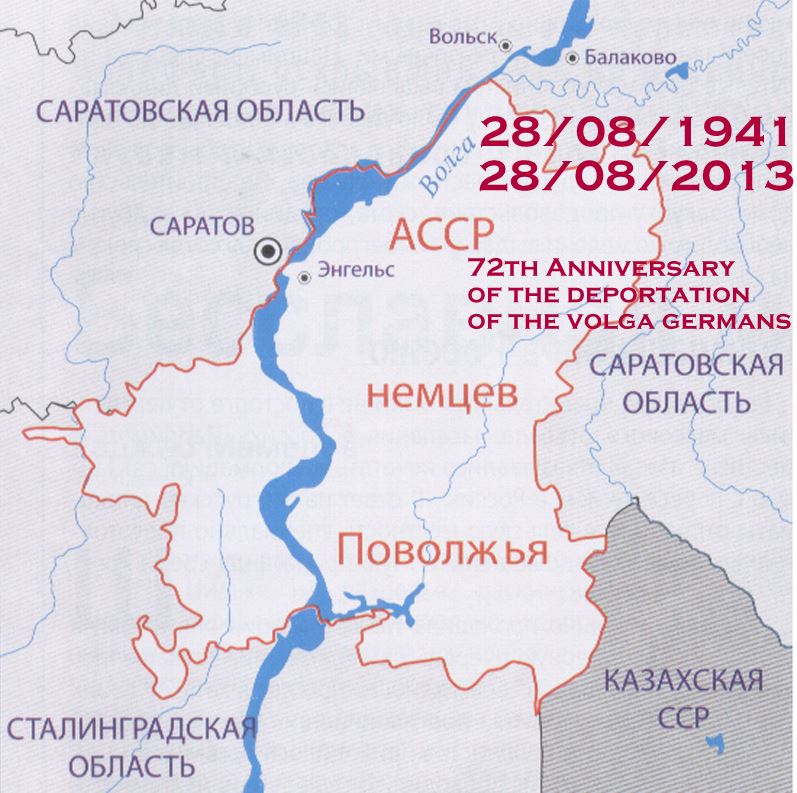
On 7 September 1941 the Presidium of the Supreme Soviet issued a decree dividing the territory of the Volga German ASSR between Stalingrad and Saratov oblasts. This occurred in the middle of the deportation of the Volga Germans from 3-20 September 1941. The map to the right shows the territorial division of the republic between the adjacent oblasts. Below I have translated the decree from Russian into English. Note the transliteration of the canton names from German to Russian and back into Latin letters may result in some differences between my translation and the original German names. But I have tried to confirm and put the original German spellings down below whenever possible.
Source: V.A. Auman and V.G. Chebatoreva, Istoriia rossiiskikh nemtsev v dokumentakh (1763-1992),(Moscow: MIGP, 1993), p. 163.
Decree of the Presidium of the Supreme SovietThe Soviet government never restored the Volga German ASSR. Along with the Crimean ASSR it was only one of two national territories at the ASSR level in the USSR belonging to deported peoples that was never reconstituted. The ethnic Germans in the Russian Federation still suffer from inequality and discrimination on the basis of natsional'nost due to their lack of a national territory to protect and promote their rights.
On the administrative construction of the territory of the former Volga German Republic
In connection with the decree of the Presidium of the Supreme Soviet of the USSR from 28 August 1941 "On resettling Germans living in the region of the Volga", it is deemed necessary to:
1. Include in the composition of Saratov Oblast the following districts of the former Volga German Republic: - Balzer, Solotoje, Kamenka, Ternowka, Kukkus, Seelmann, Krasnojar, Marxstadt, Unterwalden, Fjodorowka, Gnadenflur, Krasny-Kut, Lizenderg, Mariental, Ekheim
2. Include in the composition of Stalingrad Oblast the following districts of the former Volga German Republic: Frank, Erlenbach, Dobrinka, Pallasowka, Gmelinskaja, Old-Poltawka, Ilowatka.
Chairman of the Presidium of the Supreme Soviet of the USSR
M. Kalinin
Secretary of the Presidium of the Supreme Soviet of the USSR
A. Gorkin
Moscow, Kremlin, 7 September 1941
Source: V.A. Auman and V.G. Chebatoreva, Istoriia rossiiskikh nemtsev v dokumentakh (1763-1992),(Moscow: MIGP, 1993), p. 163.
New Shirt
I don't often buy new clothes, but yesterday I purchased a new shirt. That is picture of it over in the right hand corner. It is very different from the Obama version which says, "Make Syria into Fufu through War." At any rate I have wanted to get one of these shirts for a long time, but I have not seen any place selling them until yesterday. The company that produces them had a table at the street festival in Jamestown yesterday. So right now I am proudly wearing my "MAKE FUFU NOT WAR" shirt.
Jamestown and Usshertown
Yesterday, I went to the annual art festival along John Evans Atta Mills High Street in Jamestown (British Accra) and Usshertown (Dutch Accra). There was music, dancing, and food. I got talked into going up to the top of the lighthouse by a colleague visiting from the US for a semester. It looks a lot taller on the inside and the way up is very narrow and treacherous. The last flight is an old wooden ladder that has a broken step. At the top the platform slopes downward rather than being even so the vertigo factor is further enhanced. The only thing I have been on in recent years that compares is the Ferris wheel at Panifilov Park in Bishkek. A Ferris wheel built during the Khrushchev era and lacking any type of safety features whatsoever to prevent you from falling to your death. At any rate I had a good time at the festival. But, as a middle aged man I wish they would turn the music down a little bit. At times I felt like I was in a giant outdoor nightclub and had difficulty carrying on any type of conversation with people.
Tuesday, September 03, 2013
Letter from Beria 25 August 1941
The joint decree of the Council of People's Commissars (SNK) and Central Committee of the Communist Party of the Soviet Union (CPSU) ordering the deportation of the Volga Germans became finalized on 26 August 1941. However, earlier drafts of this resolution had already been circulated to the leadership of the NKVD and the first secretaries of the Oblast committees (Obkom) of the Volga German ASSR, Saratov Oblast, and Stalingrad Oblast before this date. A letter from 25 August 1941 by Beria, the head of the NKVD, to the Central Committee of the CPSU with the numerical designation No. 2514/B explicitly refers to an earlier draft of the 26 August 1941 decree ordering the deportation of the Volga Germans. The decision to deport the Volga Germans was thus made by the Soviet government before 25 August 1941. Below I have translated Beria's letter from Russian into English
So far I have not seen any copies of the draft referred to in this letter or any archival material on the deportation of the Volga Germans dated earlier than 25 August 1941. This letter by Beria appears to be the oldest surviving document pertaining to the operation to be unearthed by scholars to date.
Source:
N. L. Pobol and P.M. Polian, (eds.), Stalinskie deportatsii 1928-1953: Dokumenty, (Moscow: MFD, Materik, 2005), doc. 3.1, p. 287.
25 August 1941
This is in connection to your orders as presented in the draft of the resolution of the SNK and CC CPSU (B) on the orderly resettlement from the Volga German Republic, Saratov and Stalingrad oblasts.
The total local population subject to exile is 479,841 people, of this number from the Volga German Republic - 401,746 people, from Saratov Oblast -54,389 people, from Stalingrad Oblast 23,756 people.
Resettlement is to take place in the north-eastern oblasts of the Kazakh SSR, Krasnoiarsk and Altai krais, Omsk and Novosibirsk oblasts.
Attached is the accompanying draft resolution for the first secretaries of the obkoms of the CPSU (B): Saratov - tov. Vlasov, Stalingrad - tov. Chuianov, Volga German Republic - tov. Malov to familiarize themselves with.
Awaiting your orders,
People's Commissar of Internal Affairs for the Union of SSRs
L. Beria
So far I have not seen any copies of the draft referred to in this letter or any archival material on the deportation of the Volga Germans dated earlier than 25 August 1941. This letter by Beria appears to be the oldest surviving document pertaining to the operation to be unearthed by scholars to date.
Source:
N. L. Pobol and P.M. Polian, (eds.), Stalinskie deportatsii 1928-1953: Dokumenty, (Moscow: MFD, Materik, 2005), doc. 3.1, p. 287.
Monday, September 02, 2013
No to US intervention in Syria
I don't claim to be an expert on the current civil war in Syria, but I see no advantage accruing to either the US or the majority of Syrians in the proposed military intervention against the Assad regime. If the Assad regime falls it could very well be replaced by something much worse. Indeed one thing that distinguished Syria under the current Assad and his father from some other Middle Eastern regimes was its secular nature. In terms of personal freedom Syria has been considerably more liberal than places like Saudi Arabia despite the dictatorial nature of the Ba'ath Party. So while the regime has been brutal I am by no means convinced that what ever replaces it will be an improvement and it could well be far worse than what existed before the start of the civil war. The main thing US military intervention will do is add to the death toll through "collateral damage" due to bombings and missile strikes. It could very well end up that the US and whatever allies we get to support us end up killing a lot of people in Syria and an Islamic regime that makes us nostalgic for the secular Arab nationalist dictatorship of old man Assad takes power. I am sure such a scenario has its own beneficiaries, but I am failing to see how either the majority of Americans or Syrians are among them.
Disaster is Averted.
Last night the VC issued the signed letter promising the remainder of our book and research allowance that the union had requested. In return the strike has been called off and we resumed teaching this morning. Since the only outstanding union demand for ending the strike was a formal letter with a time table promising to pay the remaining $800 of our book and research allowance this is a union victory. But, I would have enjoyed my weekend more if I didn't have to worry about a possible closure of the university today. Needless, to say I am greatly relieved. For those readers in the US have a Happy Labor Day. It certainly is for me.
Sunday, September 01, 2013
Countdown to Potential Disaster
Tomorrow the VC will decide whether on not to shut down the University of Ghana for the whole academic year. If he does shut down the university it will be the worst disaster to strike Ghana in the last 30 years. I am fervently hoping not only for my own sake, but for the sake of all of the faculty, staff, and students here that he does not shut down the university. I enumerated some of the problems shutting down the university would cause in a previous post. There are of course a whole bunch of knock on effects that I have not enumerated or even imagined.
Excess Deaths in the USSR among Russian-Germans 1918-1948
The Soviet government killed hundreds of thousands of ethnic Germans through shootings, deportations, in camps, and by hunger. Between 1918 and 1948 excess deaths among Russian-Germans in the USSR due to repression and man made famine were at least 480,000 (Krieger 2013, p. 3). This is an absolute minimum figure and is equal to around a third of their 1939 population. Below is a breakdown of a very conservative estimate of the number of Russian-German victims of the Lenin and Stalin regimes made by Viktor Krieger.
Civil War and Famine 1918-1922
Volga Region - 108,000
Black Sea Region - 50,000-60,000
Total for former Russian Empire 180,000-200,000
Holodomor 1932-1933
100,000
Great Terror 1937-1938
55,000
Deportation, Special Settlements, and the Labor Army
Labor Army - 60,000-70,000
Special Settlements 1941-1945 - 70,000-80,000
Special Settlements 1946-1947 - 15,000-20,000
Total for USSR 1941-1948 - 150,000-160,000
Total for USSR 1918-1948 - 480,000-515,000
Source:
Viktor Krieger, Bundesburger russlanddeutscher Herkunft: Historische Schlusselerfahrungen und kollektives Gedachtnis (Munster: Lit Verlag, 2013), pp. 240-242.
Civil War and Famine 1918-1922
Volga Region - 108,000
Black Sea Region - 50,000-60,000
Total for former Russian Empire 180,000-200,000
Holodomor 1932-1933
100,000
Great Terror 1937-1938
55,000
Deportation, Special Settlements, and the Labor Army
Labor Army - 60,000-70,000
Special Settlements 1941-1945 - 70,000-80,000
Special Settlements 1946-1947 - 15,000-20,000
Total for USSR 1941-1948 - 150,000-160,000
Total for USSR 1918-1948 - 480,000-515,000
Source:
Viktor Krieger, Bundesburger russlanddeutscher Herkunft: Historische Schlusselerfahrungen und kollektives Gedachtnis (Munster: Lit Verlag, 2013), pp. 240-242.
Saturday, August 31, 2013
Heinz Rudolf Kunze - Ich bin auch ein Vertriebener
This is the only rock song I know of to deal with the brutal expulsion of ethnic Germans from East Central Europe at the end of WWII. For those of my readers that understand German take a good listen to the lyrics of this song.
Labor Situation Update at the University of Ghana
Yesterday, the VC refused to put anything in writing regarding the oral agreement to pay the remaining $800 of our book and research allowance from last year. Instead he is threatening to shut down the university on Monday in contrast to the assurances he gave to the Ghanaian press earlier in the week that he would not nullify the academic year. If the university is shut down on Monday it appears that our salaries might very well also be suspended for a year. The university would also by my calculation owe US study abroad programs about $6 million dollars in refunds due immediately. Money that is very unlikely to ever be generated again as I suspect many US programs will permanently cancel their existing agreements with the University of Ghana if the VC shuts down the university. The 1000 or so US exchange students would lose a year of university credit and for many of them that would also mean they would lose their financial aid. Shutting down the university would cause incredible damage to the reputation of the University of Ghana and by extension the Republic of Ghana. It will take many decades to overcome this damage if the VC goes ahead and nullifies the academic year.
Wednesday, August 28, 2013
Another UTAG Meeting
Today we had another emergency UTAG meeting. It turns out that the government and university have taken steps to pay $700 out of the $1500 owed each of us for our research and book allowance from last year. But, the promise to pay the remaining $800 given to the union only exists in an oral form at present. So the union's position is that we will remain on strike until such time as there is a written promise and time table by the VC to pay the remaining $800 to faculty and a similar written agreement by the government to reimburse the university. Unfortunately, there is a good chance that the government will refuse to put anything in writing which will mean there will be no evidence of its promise to pay this money. In that case the union will probably remain on strike. If the strike continues on past Monday then the VC will have the option of shutting down the campus and nullifying the semester. I am not sure if the impasse will be resolved by then or not. But, right now it doesn't look like I will be teaching Friday morning. I will be checking throughout tomorrow to make sure.
Syria
At least the most recent country targeted for bombing by Obama is not in Africa. It is still a colossally bad idea, however. In addition to doing nothing to bring back the innocent victims of Assad's regime it is going to add a considerable number more in the form of collateral damage. Really, US "progressives" need to stop thinking that emulating the policies of France and Israel of randomly bombing countries is somehow an acceptable substitute for an actual foreign policy. Between these three "progressive" governments they have managed to bomb Syria, Lebanon, Palestine, Libya, Mali, Ivory Coast, Somalia, Afghanistan, and Pakistan since I arrived in Africa less than three years ago. Notably all of these countries are either African or Asian. Although it is not as if there are no European regions like the Caucasus with Islamic extremists, terrorism, ethnic separatists, civil war, and mass human rights violations. Russia just happens to be politically powerful enough to prevent any US military intervention in the region while Africa, the Levant, and South West Asia are not.
Tuesday, August 27, 2013
28 August 1941
The twenty eighth of August marks the official day of commemoration of the deportation of the Russian-Germans. On 28 August 1941, the Presidium of the Supreme Soviet ordered the deportation of the Germans living in the Volga German ASSR, Stalingrad Oblast, and Saratov Oblast. This decree received the numerical designation Ukaz 21-160. Clicking on the link will bring you to an English language translation of the decree. The decree was published two days later on 30 August 1941 in both the German and Russian language newspapers of the Volga German ASSR. In the top right corner you can see a photocopy of the German translation published in Nachrichten and right below it you can see a photocopy of the original Russian as it appeared in Bolshevik. Ukaz 21-160 was the only deportation order dealing with the Russian-Germans that was published at the time it was issued. The few previous and many subsequent deportation orders ethnically cleansing the Soviet Union west of the Urals of almost all of its citizens of German ancestry did not see the light of day until decades later.
"Third World", "Tri-Continental Bloc", or just Asia, Africa, and Latin America?
I was talking to a Visiting Scholar in our department from the US yesterday who is an expert on Latin America about this. But, the term "Third World" really seems to be problematic since the disintegration of the second world. Absent a political unity in refusing to align with either the US or the USSR during the Cold War or a revolutionary commitment to anti-imperialism there is almost nothing that ties the countries of Africa, Asia, and Latin America together anymore. Indeed the term Third World was popularized as a specifically political stance of decolonizing countries in Asia and Africa at the Bandung Conference in 1955 to assert their independence from the US, Europe, and USSR. This idea received concrete organization in the formation of the Non-Aligned Movement. The idea of the peoples of Africa, Asia, and Latin America forming a distinctly revolutionary bloc opposed to colonialism, neo-colonialism, and racism reached its peak at the Tri-Continental Conference in Havana in 1966. Prior to the Havana conference Latin America had not been fully integrated into the organizations agitating for such a bloc, most notably the Afro-Asian People's Solidarity Organization (AAPSO). While including Asian members, the Cairo based organization held all of its conferences prior to the Tri-Continental Conference in Africa. The first one was in Cairo in 1957 followed by Conarky in Guinea in 1960, Moshi in Tanzania in 1963, and Winneba in Ghana in 1965. AAPSO much more so than the early Non-Aligned Movement stressed revolutionary opposition to the First World rather than a position independent of both the US and USSR. Indeed delegates from the USSR participated in the activities of AAPSO from the beginning in 1957. The idea of Africa, Asia, and Latin America forming either a third non-aligned bloc or a revolutionary anti-imperialist bloc today, however, seems far fetched. The collapse of the USSR made this first option impossible and the second one highly improbable.
Monday, August 26, 2013
Love your mama not MAMA
Robert Young has a great acronym in his book White Mythologies. It is MAMA (Male Anglo-Saxon Marxist Academia) which is an English translation of 'le marxisme analytique anglo-saxon' (Young, p. 3). It should of course not be confused with mama as in mother including Mother Africa, especially since MAMA almost completely ignore the contributions made by Africans to world history (Young, pp. 4-7). You should love your mama, see the image to the right, but MAMA is a pathology that unfortunately dominates the US and a number of other countries. The extreme Eurocentrism of white English speaking Marxists even in places where they should know better such as South Africa is pretty glaring (Young, p. 8). Young is not the only scholar to note the unjustified exclusion of Africa and other parts of the world outside Europe and North America in the dominant academic discourse, a discourse largely controlled by MAMA. Reiland Rabaka has also commented on this phenomenon although unfortunately he does not use the acronym MAMA like Young does (Rabaka, pp. x-xi). As he points out the "conventional" critical theorists are predominantly "white, unmistakably Marxist and male" (Rabaka, p. xi). They are thus the MAMA that Young points out "defend the ideas of Marxist historicism without generally acknowledging the Eurocentrism of that narrative..." (Young, p. 3). He goes on to note that "a particular problem in Marxism hitherto almost invisible in Europe and North America, namely its implacable whiteness, its Eurocentrism, an orientation most clearly evident in the accounts of history offered in its name..." (Young, p. 4). One of course also sees this orientation replicated on the Internet with almost all Left wing academic blogs. The major ones all focus almost exclusively on issues relating to Europe and North America to the almost complete exclusion of Africa.
Sources:
Reiland Rabaka, Africana Critical Theory: Reconstructing the Black Radical Tradition, From W.E.B. Dubois and C.L.R. James to Frantz Fanon and Amilcar Cabral, (Lanham, MD; Lexington Books, 2009).
Robert J.C. Young, White Mythologies: Writing History and the West, second edition, (London: Routledge, 2004).
Sources:
Reiland Rabaka, Africana Critical Theory: Reconstructing the Black Radical Tradition, From W.E.B. Dubois and C.L.R. James to Frantz Fanon and Amilcar Cabral, (Lanham, MD; Lexington Books, 2009).
Robert J.C. Young, White Mythologies: Writing History and the West, second edition, (London: Routledge, 2004).
Strike Update
Apparently there is a meeting between the UTAG leadership and VC today to discuss the strike. It appears that the union may suspend the strike for a day in order to prevent 21 consecutive days of industrial action from accumulating. That would deprive the VC of the option of shutting down the university. We are supposed to know what the status of the strike is by Thursday. If it is suspended that would mean I would go and teach this Friday. But, it would also mean that the following week that the strike would resume. If this happens I am going to try and cram as much information into my two hour lecture on main campus as humanely possible. It might be possible to cover all ten weeks of lectures in one day if I really put my mind to it. However, currently I don't have any reliable information on what exactly is going to happen this week and next week regarding the ongoing strike. UTAG's stated position is that it will continue to withhold teaching of lectures until such time as all the money currently owed to its constituent members is actually paid into their bank accounts. The arrears from last year have now been paid. But, the book and research allowance is still outstanding. I have heard rumors that the government wants to eliminate the automatic payment of the allowance and make people apply for all research grants so that they can give the money to their political allies and friends. Such a position of course is completely unacceptable to the union and if the government actually goes through with it could keep us on strike indefinitely.
Sunday, August 25, 2013
Decree No. 2056-93ss
The official commemoration of the deportation of the Volga Germans takes place every year on August 28th. That is the day in 1941 that the Presidium of the Supreme Soviet issued Ukaz no. 21-160. This decree which was published on 30 August 1941 falsely and unconstitutionally accused the ethnic Germans of the Volga German ASSR, Saratov Oblast, and Stalingrad Oblast of mass treason. This decree, however, was crafted to provide a justification for the decision made two days earlier by the Central Committee of the Communist Party of the Soviet Union and the Council of People's Commissars. This earlier decree (No. 2056-93ss) which is the actual decision states no reasons for the mass deportation of the Volga Germans. Instead it merely orders that they all be resettled to Siberia and Kazakhstan. The first page of the decree is reproduced in the original Russian language in the image in the right hand corner. An English translation is available here. This decree formed the administrative basis for the massive ethnic cleansing of the Volga Germans from 3 to 20 September 1941. Ukaz no. 21-160 issued two days later by the Presidium of the Supreme Soviet was a post-facto attempt by the Soviet government to legalize a blatantly unconstitutional decision. But, the 28 August 1941 decree was published at the time whereas the 26 August 1941 one remained secret for many decades. So the official day of commemoration for this crime against humanity is on the 28th rather than the 26th. Personally I think both days should be observed as well as the 27th which is the day Beria issued NKVD Prikaz 001158 instructing the NKVD on the proper measures to undertake this mass uprooting of humanity. Over the next couple of days I will have more posts relating to the 72nd anniversary of the deportation of the Volga and groups of Russian-Germans.
Saturday, August 24, 2013
Pan-Africanism and the Arabs of Africa
Recently I have been listening to a lot of Algerian rai music. I think Algeria has my favorite music of any African country although I like Malian music a lot as well. This brings me to the point that the Arabs and Berbers despite being White are African peoples and African is a continental, not a racial identity. More Arabs live in Africa than live in Asia and Arabic is the most widely spoken language on the African continent. One of the great Pan-African leaders of the 1950s and 1960s was Gamal Abdel Nasser of Egypt. The Pan-Africanist Casablanca group formed in 1961 originally included Egypt, Libya, Morocco, and the Provisional Revolutionary Government of Algeria (Algeria won its independence only in 1962) as well as Ghana, Guinea, and Mali. Thus out of its seven members four were predominantly Arab. Pan-Africanists like Frantz Fanon have always stressed that there is a single African continent and that both Black Africans in the south and White Africans in the north belong to it. Indeed Algeria along with Congo was one of the two great issues that occupied the Casablanca group and its constituent members. The Casablanca group went so far as to give membership to the provisional government formed by the Algerian independence movement. Both Black African and Arab African states have shown solidarity in their opposition to European colonialism, South African apartheid, and the Israeli military occupation of the West Bank and Gaza Strip. I have written quite a bit recently here on Western Sahara which is an Arab inhabited territory whose liberation has been championed mainly by African states. In fact the provisional revolutionary government of the territory, the SADR (Sahrawi Arab Democratic Republic) is a full member of the African Union. A future united Africa can not exclude its northernmost states. The Arabs and Berbers are an integral part of the African continent and the fate of countries like Egypt and Tunisia is just as important to real Pan-Africanists as Togo or Gabon.
Thank You UTAG
This morning I noticed that I had been paid about 3,000 cedis ($1,500). My understanding and it is hard to follow the exactly how the payment system here works is that this is the money that was in arrears from the 2012 market premium. That means that the book and research allowance which is supposed to be doubled from 1,800 cedis ($900) to 3,600 cedis ($1,800) is still outstanding. I got the impression from last Monday's emergency union meeting that the strike would continue until all the money owed to us was paid into our bank accounts. So I think the strike is still on. But, I will try to confirm this on Monday. I will definitely find out before Friday when I am scheduled to teach whether I am to go to class and lecture or not. At any rate I am pretty happy that at least this payment has landed in my bank account this fast. I did not expect to see this money until some time next week. I hope I get the rest of what is owed me soon. But, it is always a good start to a Saturday to find out you have a lot more money than you thought you had in your bank account.
Update: I have confirmed today with my coworkers that the 3,000 Ghana I received is the arrears I was owed, but that the book and research allowance still has not been paid. The UTAG strike will continue until we receive that payment as well. So I am still on strike until I hear otherwise.
Friday, August 23, 2013
74 Years Since the Molotov-Ribbentrop Pact
Today is the 74th anniversary of the Molotov-Ribbentrop Pact. This "nonaggression" pact was actually an alliance between the USSR and Nazi Germany from 1939-1941. Its secret protocols divided the countries in between these two states into spheres of influence. In the Soviet sphere of influence fell Finland, eastern Poland, Lithuania, Latvia, Estonia, and Bessarabia. The Nazi sphere of influence consisted of most of western and central Poland. The alliance between the USSR and Nazi Germany led to the invasion and annexation of eastern Poland, Lithuania, Latvia, Estonia, and Bessarabia by the USSR. The Stalin regime instituted a brutal reign of terror in these countries. On 14 June 1941, the Soviet NKVD deported over 40,000 men, women, and children from Estonia, Latvia, and Lithuania to Siberia and northern Russia. Here is an account from an Estonian who survived the harrowing exile to Siberia. She was one of the lucky ones. Many of the deportees from the Baltic states, Bessarabia, and the areas annexed from Poland did not survive. In fact about half of them died in a little over four years from the poor material conditions imposed upon them by the Stalin regime. The Soviet government also illegally and forcibly conscripted some 40,000 Estonian men into the Red Army of which it transferred 17,000, almost half, to forced labor detachments in Arkhangelsk Oblast. The alliance between Nazi Germany and the USSR signed 74 years ago made this brutality and many other crimes by the Soviet and Nazi regimes against the people of the Baltic states, Poland, and Bessarabia possible. As a result this day is observed as Black Ribbon Day to commemorate the victims that resulted from this pact of evil.
Today's Emergency Union Meeting (UTAG)
Today I went to a UTAG (University Teachers Association of Ghana) emergency meeting. It appears that we are on strike until such time as the government pays all of our arrears and our book and research allowance. So I won't be teaching class tomorrow morning. The union is not always very good at informing its members of when it goes on strike and when strikes end. But, now they are going to start collecting the names of faculty who continue to teach. So the union is actually serious about enforcing the strike this time. Officially the strike has been going on since the start of the semester. That means that in the first week of September that the Vice Chancellor can shut down the campus for the academic year. Currently faculty and senior staff are on strike and junior staff are set to strike in a couple of weeks if their demands are not met. I don't think that the Vice Chancellor will shut down the university. On the other hand until all of our money is actually in our bank accounts we are not going to be teaching. Already the foreign students, particularly those from the US on expensive one semester programs, have started complaining about not receiving the lectures they paid thousands of dollars for. If the strike continues or the university is shut down there is no solution for what to do with the foreign students. The university does not have the money to refund their payments or to pay faculty extra to just teach them as it did during the strike last semester. The best outcome would be for the government to pay us in full as soon as possible so we can go back to work. Otherwise it may be a real easy semester as far as teaching is concerned.
Thursday, August 22, 2013
Possible Research Project Update
It turns out there has been a fair amount amount of research already on communism in the Gold Coast and other British West African colonies during the 1920s and 1930s, much of it based on archives housed at PRAAD (Public Records and Archives Department) in Accra. I have found a number of journal articles dealing with the subject through JSTOR. So this is indeed a possible research project I could pursue here.
Tuesday, August 20, 2013
Africa not Moscow, Havana, or Beijing
Western Sahara is the last unresolved colonial conflict in Africa. In 1975 when Spain withdrew from the territory it became occupied by Morocco in opposition to the wishes of the vast majority of the indigenous population (Zunes, p. 35). The Moroccans took over the colonial role of Spain in Western Sahara much as Indonesia did for Portugal in East Timor around the same time. Despite their small numbers the Sahrawis were able to launch and sustain an impressive military and diplomatic resistance to Moroccan rule during the 1970s and 1980s. The Moroccan occupation forces have been quite brutal in their suppression of opposition to their rule.
Both the military and diplomatic resistance of the Sahrawis to Moroccan rule has been quite different politically from most national liberation movements in Africa and the greater Arab world. The political-military movement to liberate Western Sahara from Morocco is known as the Polisario (The Popular Front for the Liberation of Saguia el Hamra and Rio de Oro). The government established by the Polisario in the liberated areas of Western Sahara is the SADR (Sahrawi Arab Democratic Republic) (Zunes, p. 34). The Polisario has very little ideology apart from a desire to liberate the land of the Sahrawi people, a commitment to participatory democracy, and a "Third World" orientation particularly towards Africa and to a lesser extent towards other Arab states (Zunes, pp. 37-42). Unlike almost all other national liberation movements of the 1970s and 1980s in Africa such as the MPLA, FRELIMO, ZAPU, ANC, and SWAPO they did not closely ally themselves with the socialist bloc. In fact the Polisario never directly received any arms from the USSR, the Warsaw Pact states, Cuba, or even China (Zunes, pp. 43-44). The only European states to recognize the SADR were Yugoslavia in 1984 and Albania in 1987. (Pazzanita, p. 272). The Soviet bloc in contrast maintained good relations with Morocco, the Soviet Union being in the 1980s Morocco's largest trade partner and Romania providing weapons to Rabat (Zunes, p. 43). Other suppliers of arms to Morocco have included the US, UK, France, Israel, apartheid South Africa, and Saudi Arabia (Bhatia, p. 292). The pro-Soviet Moroccan Communist Party was always a strong supporter of Morocco's conquest of the Western Sahara (Zunes, p. 44). Instead the Polisario and SADR found their strongest support among African states. The SADR gained membership in the OAU (Organization of African Unity) in 1984 and had achieved diplomatic recognition from 74 states by 1990 (Pazzanita, pp. 271-272). These states included 27 in Africa and 14 in Latin America (Zunes, p. 42). Arms and logistical military support for the Polisario came mostly from Algeria with some support in the 1980s from Libya (Bhatia, p. 292). Thus the Polisario and SADR had a clear orientation towards non-aligned African and Arab states rather than the USSR and its allies in East Central Europe and Cuba.
The lack of attention paid to the plight of the Sahrawis and their national liberation front in North America and Europe is in part due to their lack of a Marxist-Leninist ideology and alliance with the USSR. Their African rather than Soviet orientation did not connect them with the global left in the industrialized North and instead left them isolated from the type of support groups like the ANC could mobilize on their behalf. At the same time their lack of connections with the USSR did nothing practical to help them in the eyes of the US which strongly backed Morocco in Western Sahara despite the fact that Moscow showed absolutely no interest in supporting the struggle of the Polisario. Nonetheless, the Pan-Africanism of the Polisario did garner them the support of most of the membership of the OAU showing that African states could act independently of the superpowers.
Non-Internet Sources Cited:
Michael Bhatia, "The Western Sahara under Polisario Control," Review of African Political Economy, vol. 28, no. 88, (June 2001), pp. 291-298.
Anthony G. Pazzanita, "Morocco vs. Polisario: A Political Interpretation," The Journal of Modern African Studies, vol. 32, no. 2, (June 1994), pp. 265-278.
Stephen Zunes, "Nationalism and Non-Alignment: The Non-Ideology of the Polisario," Africa Today, vol. 34, no. 3 (1987), pp. 33-46.
Both the military and diplomatic resistance of the Sahrawis to Moroccan rule has been quite different politically from most national liberation movements in Africa and the greater Arab world. The political-military movement to liberate Western Sahara from Morocco is known as the Polisario (The Popular Front for the Liberation of Saguia el Hamra and Rio de Oro). The government established by the Polisario in the liberated areas of Western Sahara is the SADR (Sahrawi Arab Democratic Republic) (Zunes, p. 34). The Polisario has very little ideology apart from a desire to liberate the land of the Sahrawi people, a commitment to participatory democracy, and a "Third World" orientation particularly towards Africa and to a lesser extent towards other Arab states (Zunes, pp. 37-42). Unlike almost all other national liberation movements of the 1970s and 1980s in Africa such as the MPLA, FRELIMO, ZAPU, ANC, and SWAPO they did not closely ally themselves with the socialist bloc. In fact the Polisario never directly received any arms from the USSR, the Warsaw Pact states, Cuba, or even China (Zunes, pp. 43-44). The only European states to recognize the SADR were Yugoslavia in 1984 and Albania in 1987. (Pazzanita, p. 272). The Soviet bloc in contrast maintained good relations with Morocco, the Soviet Union being in the 1980s Morocco's largest trade partner and Romania providing weapons to Rabat (Zunes, p. 43). Other suppliers of arms to Morocco have included the US, UK, France, Israel, apartheid South Africa, and Saudi Arabia (Bhatia, p. 292). The pro-Soviet Moroccan Communist Party was always a strong supporter of Morocco's conquest of the Western Sahara (Zunes, p. 44). Instead the Polisario and SADR found their strongest support among African states. The SADR gained membership in the OAU (Organization of African Unity) in 1984 and had achieved diplomatic recognition from 74 states by 1990 (Pazzanita, pp. 271-272). These states included 27 in Africa and 14 in Latin America (Zunes, p. 42). Arms and logistical military support for the Polisario came mostly from Algeria with some support in the 1980s from Libya (Bhatia, p. 292). Thus the Polisario and SADR had a clear orientation towards non-aligned African and Arab states rather than the USSR and its allies in East Central Europe and Cuba.
The lack of attention paid to the plight of the Sahrawis and their national liberation front in North America and Europe is in part due to their lack of a Marxist-Leninist ideology and alliance with the USSR. Their African rather than Soviet orientation did not connect them with the global left in the industrialized North and instead left them isolated from the type of support groups like the ANC could mobilize on their behalf. At the same time their lack of connections with the USSR did nothing practical to help them in the eyes of the US which strongly backed Morocco in Western Sahara despite the fact that Moscow showed absolutely no interest in supporting the struggle of the Polisario. Nonetheless, the Pan-Africanism of the Polisario did garner them the support of most of the membership of the OAU showing that African states could act independently of the superpowers.
Non-Internet Sources Cited:
Michael Bhatia, "The Western Sahara under Polisario Control," Review of African Political Economy, vol. 28, no. 88, (June 2001), pp. 291-298.
Anthony G. Pazzanita, "Morocco vs. Polisario: A Political Interpretation," The Journal of Modern African Studies, vol. 32, no. 2, (June 1994), pp. 265-278.
Stephen Zunes, "Nationalism and Non-Alignment: The Non-Ideology of the Polisario," Africa Today, vol. 34, no. 3 (1987), pp. 33-46.
The Deportation of the Volga Germans
On 26 August 1941 the Central Committee of the Communist Party and the Council of People's Commissariats of the Soviet Union issued Decree No. 2056-933ss ordering the deportation of all Germans from the Volga German ASSR and the neighboring Saratov and Stalingrad oblasts. This order came suddenly without warning and blatantly violated the Soviet and Russian constitutions. This first decree gave no reasons for the mass deportations and remained secret until after the collapse of the Soviet Union. The next day, 27 August 1941, Beria issued NKVD Prikaz 001158 detailing the measures and instructions for executing this mass ethnic cleansing (Bugai, docs. 9-10, pp. 41-47). The Presidium of the Supreme Soviet issued a second deportation decree on 28 August 1941, Ukaz 21-160, which was published in Nachrichten and Bolshevik in the Volga German ASSR two days later. This second decree falsely accused the entire ethnic German population of the Volga German ASSR, Saratov Oblast, and Stalingrad Oblast of treason without any evidence. This false accusation served as the basis for brutally punishing hundreds of thousands of innocent men, women, and children. The NKVD ruthlessly carried out the deportation of 451,986 Volga Germans to Siberia and Kazakhstan of which 365,764 came from the Volga German ASSR. The names of 2,979 of these exiles have been collected so far. The deportation of the Volga Germans was followed up by the deportation of almost all of the ethnic Germans in the USSR west of the Urals still under Soviet control. Their fate was particularly grim. The Soviet government abandoned them in the extreme climate of Siberia and northern Kazakhstan with insufficient food, housing, and medical facilities with the result that a very large number of them perished prematurely from malnutrition, exposure, and epidemic diseases during 1941-1948.
Non-Internet sources cited
N.F. Bugai, (ed.), Iosif Stalin-Lavrentiiu Berii: "Ikh nado deportirovat' ": Dokumenty, fakty, kommentarii, (Moscow: Druzhba Narodov, 1992).
Non-Internet sources cited
N.F. Bugai, (ed.), Iosif Stalin-Lavrentiiu Berii: "Ikh nado deportirovat' ": Dokumenty, fakty, kommentarii, (Moscow: Druzhba Narodov, 1992).
The US Embassy Warning
Friday, August 16, 2013
First Class of the Semester, Fall 2013
Today I had my first class of the semester. After waiting for over 30 minutes, one international student finally showed up. No Ghanaian students bothered to show up. I am hoping next week there is a greater turn out.
Possible New Research Project
Now that I know that PRAAD has nothing available after 6 March 1957, I need to formulate a new research project since obviously I can not look at the relevant Ghanaian documents dealing with the 18 December 1963 African student demonstration in Moscow. I am thinking of looking to see if there is anything in the British colonial records regarding alleged subversion by the Comintern in the 1920s and 30s. Even though the USSR really had no policy at all towards Africa until the 1950s, I am thinking that British perceptions might have been different.
Thursday, August 15, 2013
African Archives
Today I had to go to Accra City Campus to pick up a check. Since it was still morning after I finished I decided to go to the PRAAD (Public Records and Archives Department) formerly NAG (National Archives of Ghana) around the corner to see what the national government archives of the Republic of Ghana had on the African student demonstration in Moscow in December 1963. It turns out that all of the national government archives in Ghana from independence in 1957 forward are still classified and are not likely to be declassified any time soon. Indeed the existing government policy seems to be that all archives of the independent state of Ghana are to be permanently classified. Only archives from the era of British colonial rule and a bit before are available. I am wondering if any other African governments have similar policies of keeping all of their archives since independence secret and only declassifying those archives dealing with the colonial era and before. If it is in fact a wide spread policy then it is a huge obstacle to researching modern African history. The documents I wanted to look at are almost 50 years old, a time long before my birth when my parents were young, yet they are still classified along with every other central government archival document written after 6 March 1957. If anybody knows about the archival classification policies of African states other than Ghana, please leave a comment.
Sunday, August 11, 2013
Bloodlands and other Readings for Hist 435
This semester I am teaching Aspects of World History, 1914-1945 again. As in semesters past I am assigning Robert Gellately, Lenin, Stalin and Hitler: The Age of Social Catastrophe (London: Vintage Books, 2008) as the main text for the class. In addition I am also assigning Timothy Snyder, Bloodlands: Europe Between Hitler and Stalin (London: Vintage Books, 2011) to more fully cover the history of the territory between Moscow and Berlin. I am also assigning six journal articles up from four last year on various aspects of Stalinist repression to fill out the outline presented by Gellately and Snyder. I think together Gellately and Snyder do an adequate job dealing with the Holocaust and other aspects of the history of Nazi Germany, so I don't have any additional journal articles to assign dealing with that part of the class.
I am adding the Snyder text to the class in response to suggestions I received a couple of years ago when I first started teaching the course. Because it covers a greater chronological and thematic expanse I opted instead to assign the Gellatley text. This year, however, I have decided to assign both texts which will bring the reading load for students up to about 100 pages a week. I am told this is a normal amount of reading for a 400 level class.
The six additional articles I am assigning to the class are listed below.
Elza-Bair Guchinova, "Deportation of the Kalmyks (1943-1956): Stigmatized Ethnicity" in Uyama Tomohiko, ed., Empire, Islam, and Politics in Central Eurasia, Slavic Eurasian Studies, no. 14 (Sapporo, Japan: Slavic Research Center, Hokkaido University, 2007), pp. 187-221.
Katherine R. Jolluck, "'You Can't Even Call Them Women': Poles and 'Others' in Soviet Exile during the Second World War," Contemporary European History, vol. 10, no. 3, (Nov. 2001), pp. 463-480.
James Morris, "The Polish Terror: Spy Mania and Ethnic Cleansing in the Great Terror," Europe-Asia Studies, vol. 56, no. 5, (July 2004), pp. 751-766.
J. Otto Pohl, "Hewers of Wood and Drawers of Water: Russian-Germans in the Labour Army," The Eurasian Studies Society Journal, vol. 2, no. 1, (Feb. 2013), pp. 1-17.
J. Otto Pohl, Eric J. Schmaltz, and Ronald J. Vossler, "'In Our Hearts we Felt the Sentence of Death': Ethnic German Recollections of Mass Violence in the USSR, 1928-1948," Journal of Genocide Research, vol. 11, nos. 2-3, (June-Sep. 2009), pp. 323-354.
Lynne Viola, "The Other Archipelago: Kulak Deportations to the North in 1930," Slavic Review, vol. 60, no. 4 (Winter 2001), pp. 730-755.
I am adding the Snyder text to the class in response to suggestions I received a couple of years ago when I first started teaching the course. Because it covers a greater chronological and thematic expanse I opted instead to assign the Gellatley text. This year, however, I have decided to assign both texts which will bring the reading load for students up to about 100 pages a week. I am told this is a normal amount of reading for a 400 level class.
The six additional articles I am assigning to the class are listed below.
Elza-Bair Guchinova, "Deportation of the Kalmyks (1943-1956): Stigmatized Ethnicity" in Uyama Tomohiko, ed., Empire, Islam, and Politics in Central Eurasia, Slavic Eurasian Studies, no. 14 (Sapporo, Japan: Slavic Research Center, Hokkaido University, 2007), pp. 187-221.
Katherine R. Jolluck, "'You Can't Even Call Them Women': Poles and 'Others' in Soviet Exile during the Second World War," Contemporary European History, vol. 10, no. 3, (Nov. 2001), pp. 463-480.
James Morris, "The Polish Terror: Spy Mania and Ethnic Cleansing in the Great Terror," Europe-Asia Studies, vol. 56, no. 5, (July 2004), pp. 751-766.
J. Otto Pohl, "Hewers of Wood and Drawers of Water: Russian-Germans in the Labour Army," The Eurasian Studies Society Journal, vol. 2, no. 1, (Feb. 2013), pp. 1-17.
J. Otto Pohl, Eric J. Schmaltz, and Ronald J. Vossler, "'In Our Hearts we Felt the Sentence of Death': Ethnic German Recollections of Mass Violence in the USSR, 1928-1948," Journal of Genocide Research, vol. 11, nos. 2-3, (June-Sep. 2009), pp. 323-354.
Lynne Viola, "The Other Archipelago: Kulak Deportations to the North in 1930," Slavic Review, vol. 60, no. 4 (Winter 2001), pp. 730-755.
Subscribe to:
Posts (Atom)


